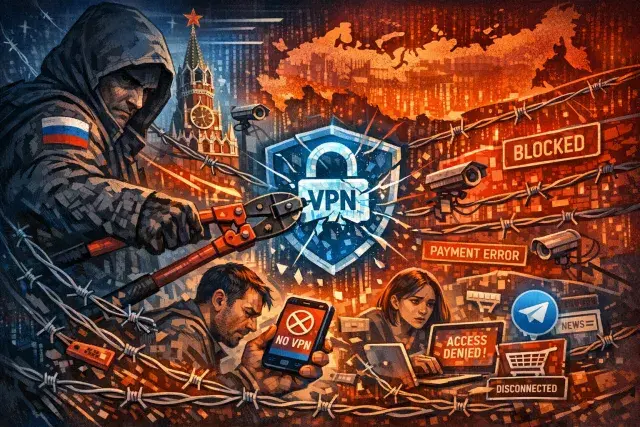

The agency responsible for blocking Russia's internet is now proposing to build its own virtual private network - not to loosen censorship, but to manage who gets around it. Roskomnadzor, Russia's federal media regulator, unveiled the proposal at a meeting with IT companies on June 8, according to independent outlet The Bell. The plan would create a government-controlled VPN specifically for IT specialists who need access to foreign platforms that the state itself has blocked or made inaccessible.
A Problem of the Government's Own Making
The immediate trigger for the proposal is straightforward and awkward for the Kremlin to acknowledge: its own censorship apparatus is now throttling the productivity of Russia's technology sector. Developers have been cut off from GitHub, the world's dominant code-sharing platform, as well as package repositories for the Python programming language and Figma, a widely used collaborative design tool. These are not peripheral luxuries. They are daily infrastructure for software engineers.
Rather than rolling back the blocks, Roskomnadzor's deputy head, Oleg Terlyakov, proposed a workaround - a unified state VPN for "those who really need it." The phrasing itself is telling. Access to global development tools, in this framing, is a privilege to be granted selectively, not a baseline condition for a functioning technology workforce.
This internal contradiction has been building for years. Russia's internet policy has long tried to pursue two incompatible goals simultaneously: maintaining a domestically competitive tech industry while enforcing an increasingly isolated and surveilled digital environment. The state VPN proposal is what happens when that contradiction becomes operationally impossible to ignore.
Why Developers Fear the Fix More Than the Problem
The reaction from Russia's IT community has been pointed and largely dismissive. Sources who attended the June 8 meeting described the proposal as "shady." Their concern is not technical - a VPN can certainly restore access to blocked resources. The concern is architectural and political.
A VPN works by creating an encrypted tunnel between a user's device and a remote server, routing traffic through that server before it reaches its destination. This conceals the user's activity from their local network and, in standard use, from the service provider. The critical word is "standard." When the VPN server is owned and operated by a state surveillance agency, the privacy calculus inverts entirely. The entity managing the tunnel has complete visibility into everything passing through it - every repository cloned, every file accessed, every communication made.
Routing the entire Russian developer community through a single, centralized government gateway would hand Roskomnadzor a comprehensive view of their professional activity. One source present at the meeting put the risk plainly: cutting off Russian developers from international tools would become even easier if everyone were already funneled through one state-controlled point. A single administrative decision could sever access for the entire sector at once.
There are also concerns about international exposure. A centralized Russian state VPN could be identified and blocked by foreign platforms on security or policy grounds, potentially making access to those same resources harder, not easier. The proposal, critics fear, also risks formalizing a two-tiered internet - one for a credentialed class of approved professionals, another for everyone else.
The Broader War on Circumvention Tools
The state VPN proposal does not exist in isolation. It arrives at a moment when Russia's campaign against privacy and circumvention tools has intensified significantly. Roskomnadzor has been blocking commercial VPN services for years, but since April, Russian internet service providers have been legally required to actively detect and block VPN connections - a more aggressive posture than simple URL-level blocking, which technical users can often work around.
The regulator has also faced accusations of conducting distributed denial-of-service attacks against VPN providers to disrupt their operations, a claim that, if accurate, would represent a significant escalation. Despite all of this, Russian officials have conceded, implicitly and occasionally explicitly, that eliminating VPN use entirely is not achievable. The cryptographic foundations of modern VPN protocols are simply too robust, and the demand too high, for enforcement to be total.
That admission matters. It reveals the state VPN proposal for what it arguably is: not a solution to a technical problem, but a strategy to bring circumvention activity inside a controlled perimeter. Commercially available VPN services that are independently audited, operate under no-logs policies, and are headquartered outside Russian jurisdiction offer users a meaningful degree of privacy protection. A state-run equivalent, by definition, cannot. The absence of a credible no-logs commitment is not a minor technical detail - it is the entire difference between a privacy tool and a surveillance instrument wearing the same label.
What Comes Next
Specific details about the proposed state VPN - its technical architecture, governance structure, or timeline - remain scarce. That opacity is itself a problem. Without clear answers on who controls the infrastructure, what data is retained, and under what legal authority it operates, Russia's developers are being asked to trade one form of restricted access for another that may be far more compromising.
The episode illustrates a dynamic playing out across multiple authoritarian and semi-authoritarian contexts: states that aggressively restrict the open internet eventually confront the economic cost of doing so, particularly in technology-dependent industries. The standard responses - building domestic alternatives, granting selective exceptions, or, as here, constructing state-managed bypass mechanisms - each carry their own contradictions.
For Russia's developer community, the calculation is bleak. The tools they need are blocked. The proposed unblock comes attached to a surveillance apparatus. And the commercial alternatives that might otherwise fill the gap are themselves under sustained attack. Roskomnadzor's state VPN may solve the access problem on paper. Whether any serious developer will trust it is a different question entirely.