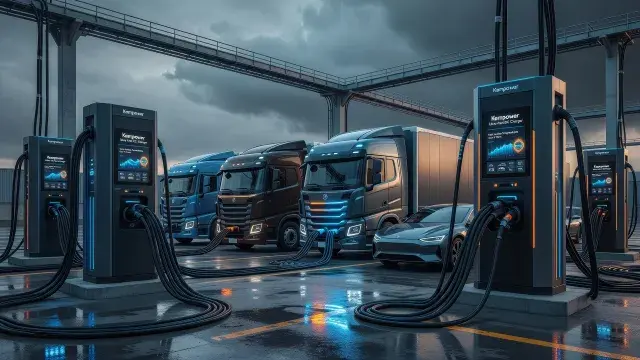
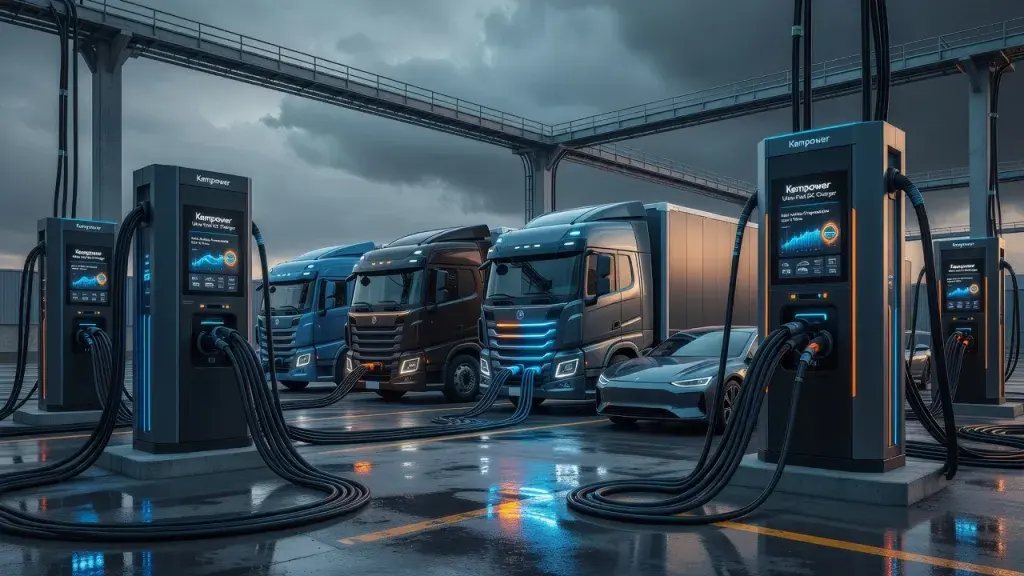
A single charging stall that can top up a passenger sedan and then, minutes later, deliver more than a megawatt to a long-haul truck is no longer a concept sketch. Kempower has unveiled the Mega Satellite Flex, a high-power dispenser that supports both the established CCS standard, at up to 560 kW, and the emerging Megawatt Charging System, at up to 1.2 MW. The Finnish charging manufacturer showed off the unit this week at ACT Expo during its Unplug & Recharge event for customers and partners.
The announcement lands at a pivotal moment for electric transport infrastructure. CCS remains the dominant standard for electric cars and light commercial vehicles across North America and Europe, while MCS is only beginning to be deployed for heavy-duty trucks that need far more power to make long routes and short rest stops workable. Building two separate systems to serve both vehicle classes has been the default approach, and it's an expensive one. Operators planning new sites, or evaluating existing charging networks, can compare plans and equipment options as this dual-standard hardware starts reaching the market in 2026. compare plans
Why One Dispenser for Two Standards Matters
Running CCS and MCS through a single piece of hardware is not merely a convenience. It changes the economics of building a charging site. Land, grid connections, permitting, and civil works are often the largest costs in any charging deployment, and they don't scale down just because a stall serves fewer vehicles. A dispenser that handles both standards from the outset means an operator can serve passenger cars, delivery vans, and heavy trucks on the same footprint, without ripping up pavement or renegotiating grid capacity later when truck traffic grows.
That flexibility also hedges against uncertainty. MCS adoption for trucks is still in its early stages, and nobody can say with precision how quickly fleets will convert. A site built around a flexible dispenser can lean toward car charging today and shift capacity toward trucks as demand materializes, rather than betting the entire investment on one trajectory.
The Technical Specifications
The Mega Satellite Flex is built to handle serious current on both sides of the standard divide. Key figures include:
- Up to 1,500 amps for Megawatt Charging System connections
- Up to 700 amps for CCS connections
- A 5-meter (16.4-foot) cable for CCS
- A 2.7-meter (8.86-foot) cable for MCS
- Optional integrated payment terminal
The unit also supports 800-volt EV architectures, an increasingly common feature in newer electric vehicles designed for faster charging sessions. Because it works within Kempower's existing distributed charging architecture, operators already running Kempower equipment can add the Mega Satellite Flex without redesigning their power distribution or control systems from scratch.
Utilization, Downtime, and the Road Ahead
For charging site operators, the core financial challenge has always been utilization: idle stalls generate no revenue, and downtime for maintenance or standard conflicts erodes margins further. A dispenser that serves both cars and trucks widens the pool of vehicles that can use any given stall, which should translate into higher usage rates from the moment a site opens, rather than waiting years for one vehicle segment to grow into the infrastructure built for it.
Kempower says the Mega Satellite Flex is expected to reach North America and Europe in July 2026. Its arrival will be a useful marker for how quickly the charging industry moves from parallel, standard-specific buildouts toward shared infrastructure - a shift that mirrors the broader push toward electrifying freight transport alongside passenger vehicles, rather than treating the two as entirely separate problems.