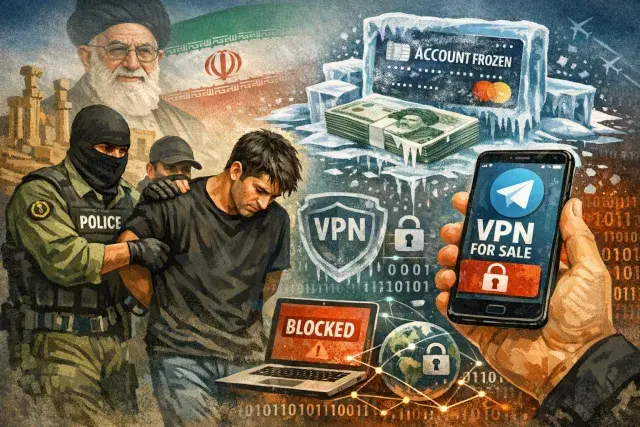

Police in Marvdasht say they have arrested a 24-year-old resident accused of selling VPN services through a Telegram channel, after what officials described as cyber monitoring and a judicially coordinated operation. According to statements carried by Fars News Agency, the suspect’s bank accounts were also frozen, underscoring how aggressively Iranian authorities are treating the online trade in circumvention tools.
The case matters beyond one arrest. In Iran, VPNs are not simply consumer software; they sit at the intersection of internet controls, platform filtering, digital commerce, and state surveillance. Any crackdown on their sale has consequences for how people access blocked websites and apps, conduct business online, and protect their communications.
Why VPN sales draw official attention
A VPN, or virtual private network, can encrypt internet traffic and route it through servers outside a user’s immediate network path. Around the world, people use VPNs for ordinary reasons such as privacy on public Wi-Fi, secure remote work, or accessing services while traveling. In tightly controlled internet environments, they also function as a practical way to reach blocked platforms and websites.
That second function is what makes them politically sensitive in Iran. Authorities have long sought to regulate access to foreign platforms and online services, while many citizens, freelancers, small businesses, and media users rely on circumvention tools to remain connected. Selling VPNs openly on social media therefore becomes visible evidence of a market that exists because demand remains strong despite repeated restrictions.
The enforcement pattern behind the arrest
According to the police account, investigators identified a Telegram channel advertising VPNs on a large scale, then traced one of the main suspects through technical measures before making the arrest. That sequence reflects a broader enforcement model: monitor digital platforms, identify payment trails, and connect online activity to real identities through banking and telecom records where possible.
The freezing of bank accounts is especially significant. It suggests that authorities are not focused only on shutting down a channel or detaining an individual, but on disrupting the financial infrastructure behind the trade. For sellers, payment systems are often the most vulnerable point. For buyers, such actions can push the market further into informal and less transparent channels.
The larger digital risk for ordinary users
Crackdowns on VPN sellers do not eliminate demand. They can, however, make the market more opaque. When legitimate or better-known sellers disappear, users may turn to unfamiliar apps, resellers, or unofficial configuration files whose security is difficult to assess. That creates room for fraud, malware, weak encryption, or services that claim to protect privacy while collecting user data.
This is one of the central contradictions of restrictive internet policy: the harder access becomes, the more people are driven toward improvised technical workarounds. Some of those tools may function well; others may expose users to far greater risks than they understand. In that sense, enforcement against sellers is not only a policing story. It is also a digital safety story.
What this case signals
The arrest in Marvdasht points to continued official pressure on the commercial ecosystem that supplies internet circumvention tools. Even when authorities frame these actions as targeted law enforcement, they also send a broader warning to people who run channels, process payments, or advertise access services online.
For readers watching Iran’s internet landscape, the core issue is clear: demand for open access has not disappeared, and state efforts to control that access have not ended. The result is an ongoing struggle over who gets to shape the terms of connectivity, privacy, and everyday digital life.