
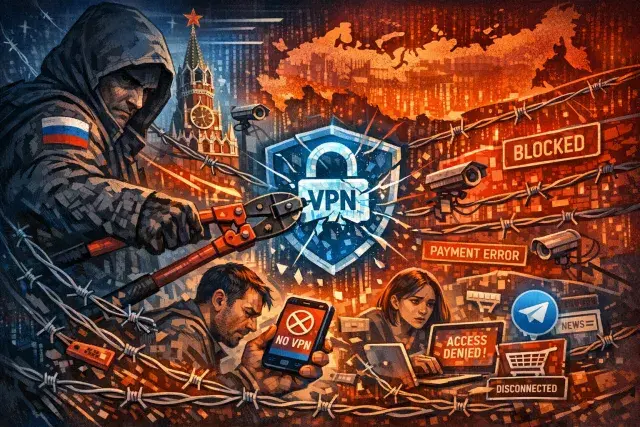

Russia is stepping up pressure on virtual private networks even as millions of people rely on them to reach blocked platforms, protect communications, and keep parts of daily digital life working. The latest measures show how internet control in Russia is no longer limited to censoring individual sites; it is becoming a broader effort to shape what remains reachable, how people pay for access, and which services can function during disruptions.
VPNs have become part of ordinary internet access
For many Russians, VPNs are no longer niche privacy tools. They are a practical response to a heavily filtered online environment in which major foreign platforms have been restricted since 2022. That has changed the role of VPNs from optional software into infrastructure for ordinary tasks: reading news, contacting people abroad, running online businesses, and accessing services that depend on foreign networks.
This helps explain why the crackdown carries wider consequences than a typical censorship measure. When a state blocks a news site, the impact is narrower. When it interferes with the tools people use to reach large parts of the internet, the disruption spreads into banking, transport, retail, and work. Reports of payment failures and manual workarounds show how closely modern digital systems are linked, and how attempts to filter traffic can spill into services the authorities do not intend to break.
Control is expanding beyond app bans and site blocking
Russian regulators have already blocked hundreds of VPN services, banned their advertising, and pressed app stores to remove them. They have also made access harder by restricting payment channels for foreign platforms. The new requirement for major domestic websites to block VPN traffic or face penalties points to a more demanding phase: shifting responsibility from regulators alone to the wider Russian internet sector.
That approach fits a larger model of state control. Mobile internet shutdowns in some regions and the use of official white lists during disruptions suggest a system designed not only to block unwanted content, but to preserve a smaller approved version of the internet when authorities decide broader access is risky. This is a more controlled structure than simple censorship. It aims to determine which parts of the network remain usable at all.
Telegram sits at the center of the pressure
The importance of Telegram makes this campaign especially sensitive. In Russia, Telegram is not just a messaging service. It functions as a news distributor, an official communications channel, a business tool, and a platform for political speech. State bodies use it, independent media use it, and opposition figures use it. Any technical move that affects traffic linked to Telegram or the tools people use to keep it accessible can ripple across public communication.
That creates a tension for the authorities. A harsher blockade may satisfy political goals, but it also risks disabling a platform that has become embedded in everyday institutional and commercial life. This is one reason experts doubt a total VPN ban is realistic. The same systems used to restrict access can damage the digital plumbing that businesses, agencies, and consumers depend on.
Why a complete ban remains difficult
Comprehensive VPN enforcement is hard in any large, connected economy. VPN services change domains, rotate servers, disguise traffic, and adapt quickly when one route is blocked. States can raise the cost and inconvenience of access, but eliminating it entirely is far more difficult, especially when companies and professionals also rely on encrypted connections for legitimate work.
Russia appears to be pursuing a strategy of attrition instead: make VPNs harder to find, harder to pay for, harder to download, and less reliable to use. That can reduce casual access without formally outlawing every encrypted tunnel. But the trade-off is growing friction across the digital economy. The more aggressively authorities interfere with traffic patterns, the greater the risk of collateral failures in payments, communications, and essential online services.
The result is a fragile balance. Russia wants tighter control over information flows without severing the networks its economy still needs. Users, meanwhile, continue to adapt. That is why the struggle over VPNs is about more than circumvention software. It is about whether a modern state can narrow the internet to a manageable, approved space without damaging the systems that keep daily life running.